The science behind FungopiaLife Underground
Every rule in Fungopia mirrors a real biological process. Here is the story of how mycorrhizal fungi actually live, and how each chapter maps to the game you are playing.
Fungopia's rules mirror the real biology of mycorrhizal fungi. This nine-chapter tutorial walks through germination, colonisation, dispersal, symbiosis, fruiting, competition, defence, adaptation, and dominance — pairing each step in the lifecycle with the in-game mechanic it inspires.
Game mechanic tagsHypha networkTaproots / carbsMushrooms / sporesAdaptation cardsCompetitionImmunityScoring
Chapter 1: Germination
The spore awakens
A mycorrhizal fungus begins life as a microscopic spore resting in the soil. When chemical signals from nearby plant roots diffuse through the earth (sugars, strigolactones, flavonoids), the spore germinates and sends out its first thread. The reach is tentative: the hypha grows toward the root signal, branching and exploring. Without a host, the fungus cannot persist.
SetupSpore placement. Each player seeds the board with spores before the first turn.
HyphaFirst hypha sprouts from a spore adjacent to the tree.
Chapter 2: Colonisation
Building the mycelial network
Once contact is made, the fungus proliferates rapidly. Hyphae, thread-like filaments only a few micrometres wide, branch and fuse to form the mycelium: a web of astonishing reach. A teaspoon of healthy forest soil may hold kilometres of these filaments. The network extends far beyond any individual root tip, foraging for phosphorus, nitrogen, and water. Growth is the fungus's primary strategy: expand, claim territory, beat rivals to unexplored patches.
GrowGrow action: extend hypha along any vacant edge connected to your network.
Chapter 3: Dispersal
Spores as advance scouts
Real mycorrhizal fungi can propagate vegetatively, but many also release spores that drift through wind, water, and animals to colonise distant ground. A spore landing on an unconnected patch is a gamble: it must survive long enough to germinate. In the soil this "resting" phase is metabolically costly: the spore draws on its reserves while it waits. Only after a delay does the investment pay off.
SproutSprout action: a spore placed in a prior turn is converted into hypha, often deep in contested ground.
Spore cycleDecayed → fresh spores model the metabolic cost and recovery of waiting.
Chapter 4: Symbiosis
The carbon economy of the forest
The mycorrhizal relationship is fundamentally an exchange of goods. Trees are sugar factories: photosynthesis generates carbohydrates the tree cannot fully use alone. Up to 30% of a tree's photosynthate flows directly into the mycorrhizal network. In return the fungus delivers phosphorus, nitrogen, and water, minerals the tree's own roots cannot reach efficiently. Tap-root zones are the richest sites for this exchange.
TaprootTaproot tiles: immediate carbohydrate gain on hypha placement.
CarbsCarbohydrate tokens represent photosynthate flowing from tree to fungus, your in-game currency.
Chapter 5: Fruiting
Why mushrooms appear
A mushroom is not the fungus, it is the fungus's reproductive organ, erupting above ground only when the mycelium is mature and conditions are right. Forming a fruiting body requires the convergence of many hyphae at a single point and a surge of resources. The payoff is twofold: it releases millions of spores for long-distance dispersal, and signals that the local network is robust and well-fed. Fungi that fruit successfully have, by definition, controlled enough territory to afford the cost.
FormMushroom forms when 3 of your hypha meet at an intersection.
RewardCarbohydrate gain + spore refresh on fruiting = the metabolic reward of reproduction.
Score1 victory point per mushroom: territorial fitness made visible.
Chapter 6: Competition
Fungus versus fungus
Soil is not empty. Multiple fungal species compete fiercely for the same root surfaces and the same carbon. When two mycelial networks meet, they engage in a chemical arms race. Some deploy antifungal metabolites to kill or repel rivals. Others overgrow, displacing the competitor by sheer biomass. In extreme cases one fungus parasitises another (mycoparasitism). Some species form sclerotia, dense, hardened knots that survive in isolation, waiting for conditions to improve.
OvergrowSprout can replace an opponent's hypha, aggressive overgrowth.
CardAntifungal Metabolite: force an opponent's hypha to relocate.
CardSclerotia Formation: place an isolated hypha disconnected from your network.
CardFungicolous: mycoparasitism, swap two hypha positions.
Chapter 7: Defence
Priming the immune response
Plants colonised by beneficial mycorrhizal fungi show mycorrhiza-induced resistance (MIR): a primed immune state that lets them respond faster to pathogens and pests. The fungus itself also develops chemical defences over time, including tolerance to the antifungal compounds secreted by rivals. Some networks actively colonise areas disturbed by insect herbivores, exploiting the weakened root systems. Immunity is not static; it is built through investment and experience.
TokenImmunity tokens: purchased with carbohydrates, permanent for the rest of the game.
CardImmune Priming: mycorrhiza-induced resistance, gain a bonus token.
TerrainInfested tiles: only high-immunity fungi can colonise pest-damaged zones.
TiebreakImmunity breaks ties: the better-adapted fungus wins contested territory.
Chapter 8: Adaptation
Evolutionary tricks of the trade
Mycorrhizal fungi are extraordinarily adaptive. Adaptive growth describes how hyphae retract from unproductive zones and redirect resources to high-yield areas: a real process of hyphal turnover. The Cordyceps genus famously parasitises insects, fruiting directly from the host body; some mycorrhizal fungi similarly exploit insect cadavers as nutrient hotspots. Mycophagy, animals eating mushrooms, is not always bad for the fungus: spore dispersal through animal guts can outweigh the cost.
CardAdaptive Growth: relocate one of your hypha within your network.
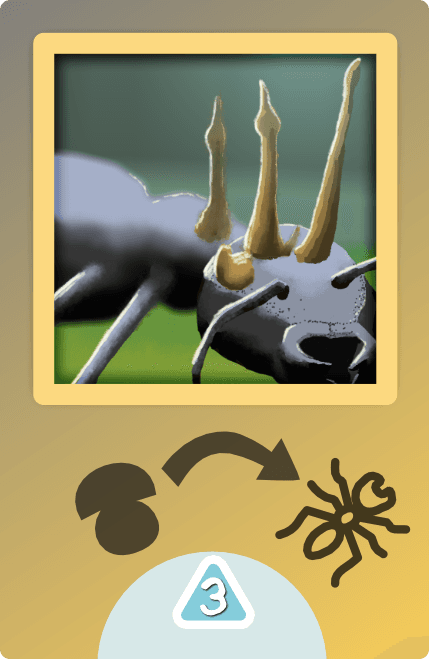
CardCordyceps Parasitoid: grow a mushroom on an insect vertex.
CardMutualistic Mycophagy: sacrifice a mushroom for a carbohydrate burst.
Chapter 9: Dominance
What it means to win the soil
In a forest, no single fungal species wins permanently, but dominant species are those that control the most root surface, form the longest and most connected networks, and produce the most reproductive structures. Research on the "wood wide web" shows that the most influential fungi are hubs: species whose mycelium spans multiple trees, mediating resource flow across the whole ecosystem. The longest, most continuous network is the most resilient, and the most valuable.
ScoreTile control points: root surface dominance.
ScoreMushroom points: reproductive success.
ScoreLongest Mycelium Trophy: network connectivity and reach.
Every move you make in Fungopia has a biological counterpart. Grow a hypha. You are foraging. Form a mushroom. You are reproducing. Buy an adaptation. You are evolving.